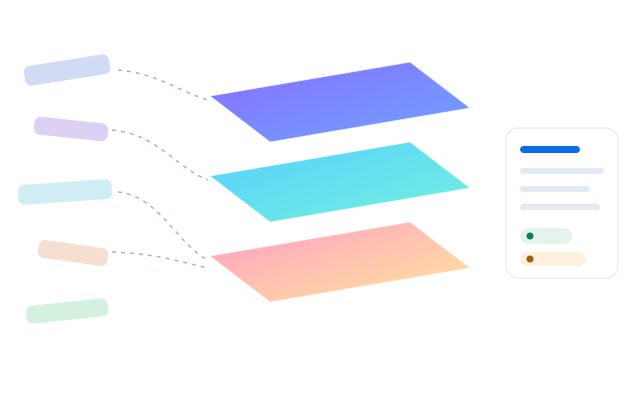
A dataset you specified, delivered clean.
You describe the data you need and what it is for. We agree a written specification, show you a sample built to it, then deliver the scoped dataset. Nothing for your engineers to build or maintain.
When this is the right thing to buy
Data Extraction is a defined job with an end. If what you actually need is an ongoing supply of accounts to sell to, that is a different conversation — and one we would rather have honestly than sell you the wrong thing.
You know what you want
You can describe the dataset — the companies, the fields, the markets. The hard question of who to sell to is already settled.
It is a project, not a habit
A market study, a migration, a one-off analysis. You want the file, not a relationship with a platform.
Your engineers stay on your product
Let your engineers stay focused on what you sell while we manage a defined data project end to end.
You want to test us cheaply
A bounded piece of work is a sensible way to find out whether we are any good before you consider anything ongoing.
Source context stays available
If your compliance team, your board or your client asks where something came from, the source context is there for review.

How a project runs
Five steps. The second one is the one that matters — you look at real output before there is anything meaningful to pay for.
We write the specification together
What one record represents, every field by name, what counts as a valid value, which markets are in scope and what is knowingly excluded. Most disappointing datasets are disappointing because this step was skipped.
You get a real sample
Actual records in the agreed shape, not a formatted mock-up. Small enough to read line by line, which is exactly what we want you to do.
You mark up what is wrong
A field defined loosely, a boundary drawn in the wrong place, a distinction that matters to you and not to us. The specification changes here, before scale makes it expensive.
The full set is delivered
Delivered as a structured file in the agreed format, built to the specification you approved.
What a delivered record looks like
The specification sets out which fields carry source context, a checked date and a state. The illustration below shows how that appears in a record.
Delivered where you actually want it
The file is yours. There is no viewer to log into and no seat to buy in order to read what you have already paid for.
What we will not collect
Worth reading before you brief us, because it occasionally rules out the exact thing somebody was hoping to ask for.
- Anything behind a login or a paywall. If it takes an account to see it, we do not take an account to see it.
- Anything a site has asked automated visitors not to take. A stated restriction is treated as binding, not as an obstacle.
- Personal data unrelated to a business purpose. Home addresses, personal accounts, private lives. A business contact in a business role is a different matter.
- Special-category personal data. Health, beliefs, ethnicity, and the rest of it. Not at any price and not for any brief.
- Circumvention of technical protection. If somebody built a wall, we do not sell you a ladder.
- Republished data we have no right to pass on. Being able to read something is not the same as being able to sell it to you.
If a brief needs any of the above, we will say no and explain why rather than quietly deliver it and leave the exposure with you. More on this on responsible data.
Against the usual alternatives
Three honest ways to get a dataset. This one is not always the right answer.
Questions we get asked
What does it cost?
Priced per project, on the specification. Field count, market size and how findable the market is move the number far more than record count does. We quote against the written specification, not against a vague description, which is another reason step one exists.
How long does it take?
The specification and sample are the quick part. The full run depends on scope, and we give you a date with the quote rather than after you have paid.
Do you guarantee accuracy?
We guarantee the standard in the specification — the record shape, the deduplication rule, the sourcing rules, blanks flagged rather than guessed. Anyone quoting you one accuracy percentage across all fields and all markets is quoting a marketing figure. Where records do not match the agreed specification, we will work with you to correct them under the project contract.
Who owns the data?
Ownership, permitted use and any onward transfer are set out in the project contract for each engagement.
Is this legal?
Each brief is assessed for scope, and for legal review where appropriate, before we take it on. We do not offer a blanket legality assurance, because that depends on the source, the jurisdiction and how the data will be used. The boundary is the product. Where a brief sits close to the line we will tell you, in writing, before starting.
Can this become an ongoing arrangement?
Each project is scoped and quoted individually today. If you expect to need the same dataset again, tell us in the brief and we will discuss it as a separate piece of work. A continuously-running subscription product is in development and is not something you can buy yet — when it exists we will say so here rather than sell it early.
What if we do not know what we want yet?
Then this is the wrong product and a target market build is the right one. If the target is still taking shape, begin with a Target Market Build.
Tell us what the dataset needs to contain.
We will write the specification with you, and a reviewable sample is part of the agreed process.